(208) 459-4138
 Request Samples
What Is a Board Foot? How Lumber is Measured & Quoted
Posted on: May 4, 2026
If you’ve ever reviewed a lumber quote and wondered why it’s sold in board feet instead of square feet or lineal feet, you’re not alone. Builders, architects, and homeowners ask us this all the time.
A board foot can feel old-fashioned at first, but it’s still the fairest way to measure lumber when products come in many different thicknesses, widths, lengths, and profiles.
For anyone designing, estimating, or buying wood products, the real value is simple: you want to know your required square footage, lineal footage, or piece count will be covered properly and the board footage was quoted fairly and accurately.
Key Takeaways: The Quick Summary
What is a Board Foot? It is a measurement of wood volume equaling exactly 144 cubic inches, rather than just length (lineal foot) or surface area (square foot).
Nominal vs. Actual Dimensions: Board footage is always calculated using the nominal (starting) dimensions of the wood, not the final milled size.
Face Loss Multiplier: Profiled products (like shiplap or tongue & groove) require more nominal material because coverage is reduced by laps, grooves, and reveals.
Overage: Additional material (typically ~15%) is included to account for cuts, waste, and real-world installation conditions
The MTP Difference: You don’t need to do the math. Just provide your required square or lineal footage, and Montana Timber Products will calculate the exact board footage, yield, and overage to ensure your project is fully covered.
How to Calculate a Board Foot?
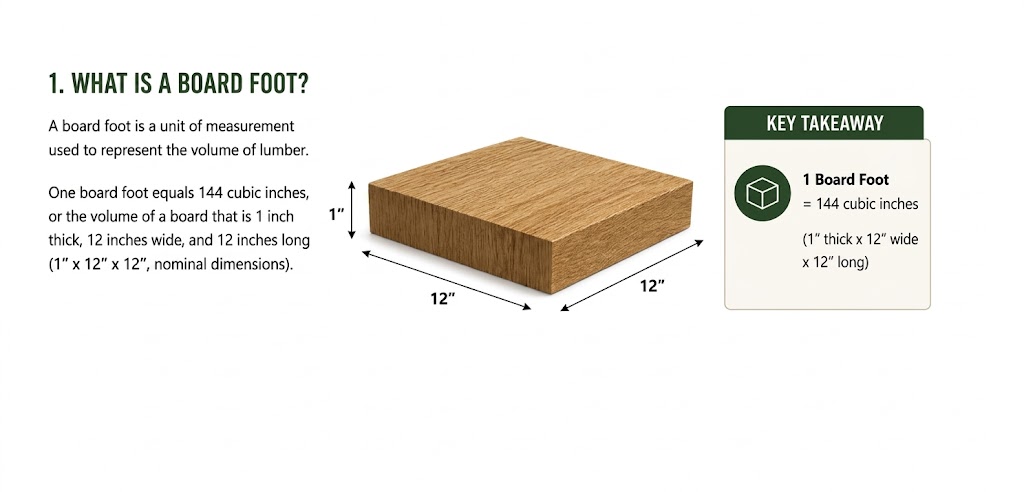
A board foot is a unit of measurement used to represent the volume of lumber. One board foot equals exactly 144 cubic inches. The easiest way to visualize this is the volume of a board that is 1 inch thick, 12 inches wide, and 12 inches long (1″ x 12″ x 12″, nominal dimensions).
The Most Important Distinction: Nominal vs. Actual Dimensions
This is one of the most misunderstood parts of lumber estimating. Board footage is calculated using nominal dimensions, not finished dimensions.
Nominal dimensions refer to the board’s size before it is milled into its final profile. For example:
- A 2×6 is priced and measured as 2″ x 6″ nominal.
- Its finished actual size may be closer to 1.5″ x 5.5″.
That finished size matters for specifications and installation, but board footage is always based on the original nominal starting size.
Rule of thumb:
Board foot formulas, wholesale lumber pricing, and material takeoffs all rely on nominal dimensions.
Why Board Feet Is Still Relevant Today?
Board feet became the standard because lumber comes in many sizes and forms. A single unit of volume allows mills, suppliers, builders, and owners to speak the same language.
Modern projects often include a mix of:
- Profiled siding
- Timber components
- Decking
- Trim boards
These products vary in thickness, width, length, profile yield, species, and grade. A board foot gives everyone a common baseline: how much nominal wood is actually in the product. That makes it the equalizer across a vast offering of dimensions and profiles.
Why Do We Sell in Board Feet Instead of Lineal Feet?
Lineal footage only measures length (1 lineal foot = 12 inches of length). It completely ignores width and thickness.
Calculating Board Feet from Lineal Footage
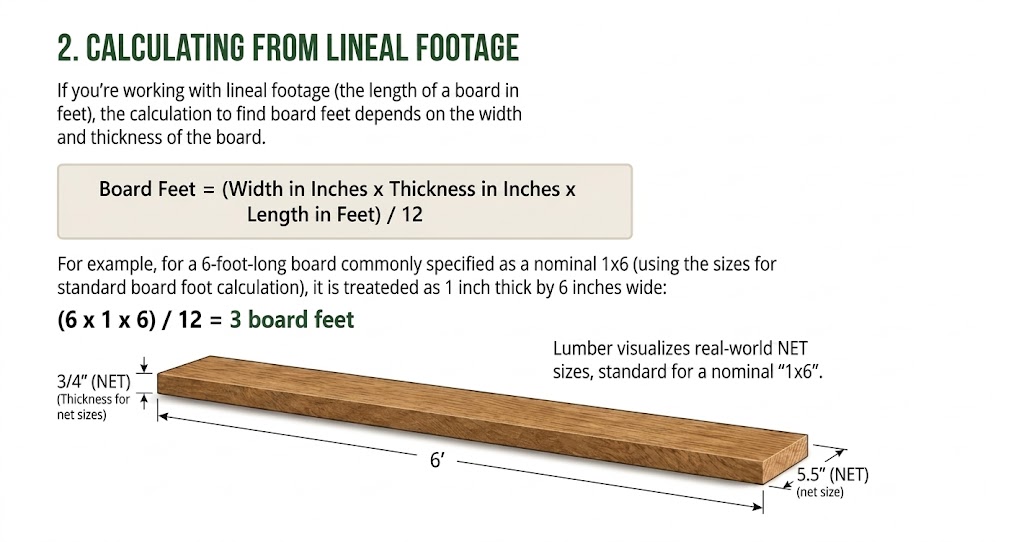
If you’re working with lineal footage (the length of a board in feet), the calculation to find board feet depends on the width and thickness of the board.
The Formula:
Board Feet = (Width in Inches × Thickness in Inches × Length in Feet) ÷ 12
For example, for a 6-foot-long board commonly specified as a nominal 1×6, it is treated as 1 inch thick by 6 inches wide: (6 × 1 × 6) ÷ 12 = 3 board feet. (Note: The actual net size of this board would standardly be 3/4″ thick by 5.5″ wide, but board foot calculations always use the nominal sizes).
Why Not Square Footage?
Square footage only measures surface coverage: Length × Width. That works perfectly for flooring, roofing, drywall, or paint coverage, but it does not account for changes in thickness.
Calculating Board Feet from Square Footage
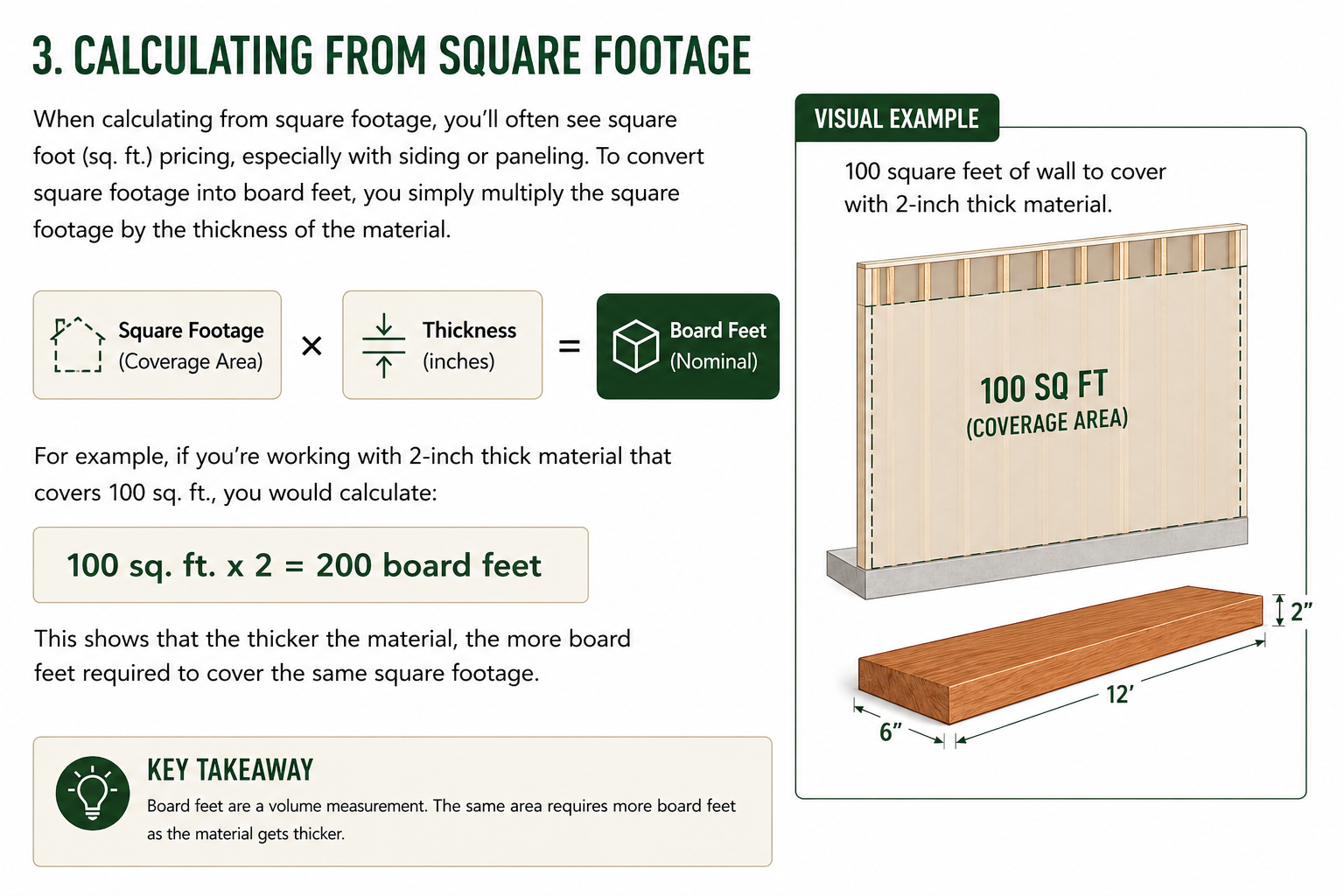
When calculating from square footage, you’ll often see square foot (sq. ft.) pricing, especially with siding or paneling. To convert square footage into board feet, you simply multiply the square footage by the nominal thickness of the material.
The Formula:
Board Feet = Square Footage (Coverage Area) × Thickness (in inches)
For example, if you’re working with 2-inch thick material that covers 100 sq. ft., you would calculate: 100 sq. ft. × 2 = 200 board feet
This shows that the thicker the material, the more board feet required to cover the same square footage.
How Profiled Products Affect Board Footage
For rough-sawn, square-edge material, square footage can convert fairly directly using nominal thickness. But for profiled products like shiplap, channel rustic, tex gap, or tongue & groove, additional calculation is required.
That’s because the visible face of the installed board is often smaller than the board’s nominal starting size.
The Face Loss Multiplier
A face loss multiplier adjusts for the difference between the board’s nominal width and the board’s net visible face after profiling and installation.
Example: 1×6 Shiplap If a 1×6 profile has a 4.75″ net face:
- 6.00 ÷ 4.75 = 1.26 Multiplier
That means more nominal board footage is required to cover the finished wall area.
The Formula:
Board Feet = Net Square Feet × Nominal Thickness × Face Loss Multiplier (This ensures enough material is supplied to cover the project properly without falling short).
Board Foot vs. Square Foot vs. Lineal Foot
| Unit | Measures | Best For |
| Lineal Foot | Length | Trim runs, perimeter, railing |
| Square Foot | Coverage Area | Floors, walls, ceilings, decking coverage |
| Board Foot | Wood Volume | Lumber pricing, comparing dimensions, mixed product orders |
What We Want You to Take Away
You don’t need to do the math. That’s our job.
Most customers think in square feet, lineal feet, or piece counts. Our job is to convert those quantities into the correct board footage required for the project and show both the usable quantity (SF/LF) and calculated BF on your quote.
We also account for important real-world factors such as profile loss, yield, and overage so the quoted quantity is built to complete the job.
Example:
If a project requires 500 BF and includes 15% overage, the quoted quantity would be 575 BF.
You don’t need to master board foot formulas. You just need confidence that:
- Your project quantities are properly covered.
- The board footage was calculated fairly and accurately.
- Profile loss, yield, and overage were considered.
- You can compare quotes with confidence.
- You understand exactly what the quote represents.
A Better Way to Read Your Quote
When you receive a proposal from Montana Timber Products, look for four things:
- The usable quantity — square feet, lineal feet, or pieces.
- The product selected — species/grade and profile.
- The calculated board footage — the lumber volume required to supply it.
- The assumptions included — yield and overage.
That gives you full visibility into exactly how the number was built.
Need Help Estimating Your Project?
At Montana Timber Products, we help homeowners, contractors, and design professionals turn plans into accurate material packages every day.
Whether you have square footage, lineal footage, blueprints, or just an idea—we can help translate it into the right lumber order. We also provide takeoff and quotation support as a courtesy so you can validate scope, pricing, and quantities with confidence.
Contact us today for takeoff support, pricing, or product guidance.